
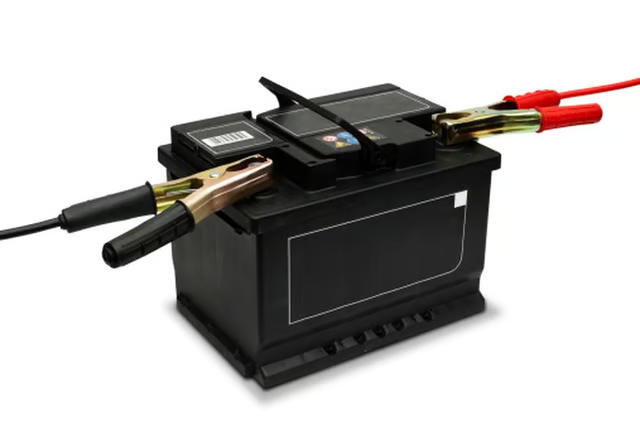


There are two ways a 6-volt and 12-volt battery can be connected. The first is a series connection. In a series connection, the two battery voltages will add together to provide a combined voltage of 18 volts. The second configuration is a parallel connection. This configuration requires a voltage splitter or isolator to keep the 12-volt battery from overloading the 6-volt battery. In this case, the total voltage will be between 6 volts and 12 volts.
Place both batteries on a table. Cut off six 3-foot pieces of 16-gauge wire. Strip half of an inch of insulation off of the ends of each wire. Connect the positive terminal of the 6-volt battery to the negative terminal of the 12-volt battery using the 16-gauge pieces. This places the two batteries in series.
Use a voltage meter to measure the voltage across the two batteries. Turn on the voltage meter and place the red positive probe on the positive terminal of the 12-volt battery. Place the black negative probe on the negative terminal of the 6-volt battery. The voltage should be at or close to 18 volts.
Disconnect the wires on the batteries.
Connect the positive terminal of the 6-volt battery to the positive terminal of the 12-volt battery. Connect terminal one of resistor #1 to the negative terminal of the 12-volt battery. Connect terminal two of resistor #1 to terminal one of resistor #2. Connect the negative terminal of the 6-volt battery to terminal one of resistor #2.
Check the total voltage for this circuit. Connect the positive probe of the voltage meter to the positive terminal of the 12-volt battery. Connect the negative probe to terminal two of resistor #2. The voltage should be between 6 volts and 12 volts. The two resistors act as voltage dividers to reduce the voltage of the 12-volt battery to a 6-volt level so that the 6-volt battery can be added to the configuration.