
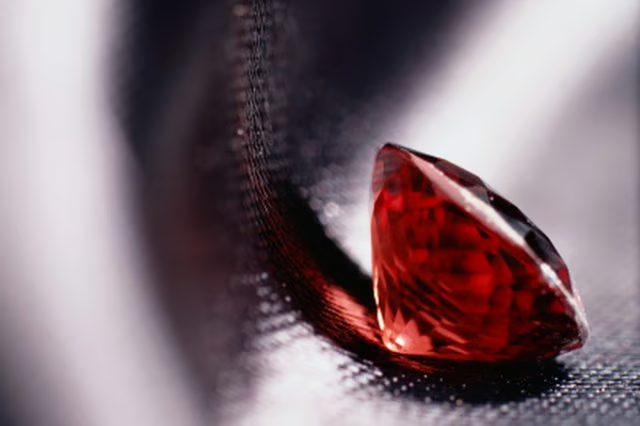


Garnets can be found in every color except blue, but the most commonly known color is red. Garnets are also the traditional birthstone for January and the official gemstone of New York. Many varieties of garnet can be found in the United States and are a popular gemstone for jewelry makers. The easiest way to identify a garnet is by eye.
Pick up the stone and hold it very close to your eye, so close that when you blink your eyelashes touch the stone. The stone needs to be close enough so that you can actually look through the table. The table is the top part of a faceted stone.
Look through the table at a bright light source 6 feet away. This light source could be a window or a bright lamp. The refractive properties of gemstone will cause rainbows and the properties of these rainbows can determine whether or not this stone is a garnet.
Roll and twist the garnet in front of your eye and focus on one large rainbow. Garnets display almost every color of the rainbow. You should observe bands of blue, green, yellow, orange and red. Pay particular attention to the green and yellow bands. If you are mistaking a ruby for a red garnet, this is an easy way to distinguish between the two, as rubies will not display green or yellow bands.
View the garnet in both natural and artificial light. A real garnets will change colors in both lights.
Perform a hardness test. Garnets are a 7-7.5 on the Mohs Scale. Steel has a hardness of 5 of the Mohls Scale, so you should be able to scratch steel with a garnet, but you should not be able to scratch a garnet with something like a steel blade. Quartz is also a 7-7.5 on the Mohs Scale, so if you have a piece handy you can test with quartz. You should not be able to scratch quartz with the garnet or vice versa. If you can scratch the stone with either the quartz or the steel, chances are it is not a garnet.
Contact a professional for definitive identification which includes equipment for measuring density, various optical properties and thermal conductance.