
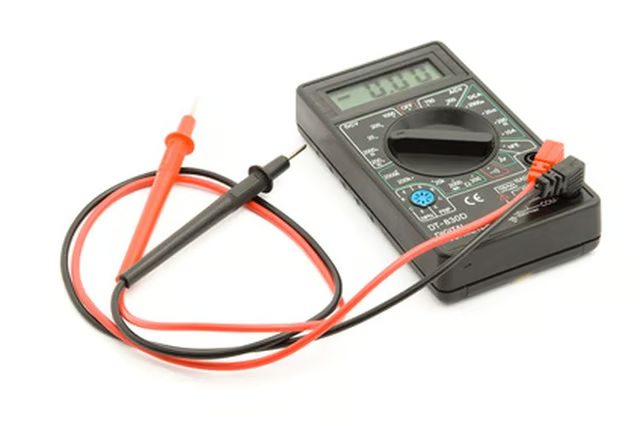


Testing the current flow within a guitar's pickups shows if it is functioning properly. Specific pickup models run at specific current flows; the manual for a guitar pickup should list what current flow is desirable. You can use a multimeter to test the current flow within a guitar pickup. Multimeters come in varying forms and at varying costs, but even the simplest should test Ohms, a measure of resistance in electric circuits. By testing a guitar pickup with a multimeter, you can make sure the desired current is present.
Unscrew and remove the pickup from the guitar. Make sure the guitar is not plugged into the amp.
Disconnect the pickup’s ground wire and hot wire from the pots inside the guitar.
Plug the multimeter in and connect the red and black probes into their correct slots on the multimeter. The black wire is connected into the “COM” slot (short for common) and the red is connected into the “V (OHM) MA” slot.
Set the multimeter to the "OHM" setting.
Touch the multimeter’s black wire to the pickup’s ground wire (which may also be black).
Touch the multimeter’s red wire to the pickup's “hot” wire (this may be a red or white wire).
Read the display panel of the multimeter. The number may fluctuate for a moment, but then will settle on one number.
Compare the Ohm reading on the multimeter to the desired figure in the guitar pickup’s manual. Different guitar pickups run at different Ohms, so it is important to know what reading your pickup should produce. Typically, an Ohm reading between 3 and 10 is desirable.
Warnings:
- Make sure the guitar is not plugged into the amp when you remove the pickup. Heed electrical warnings and proper use instructions in the multimeter's manual.